
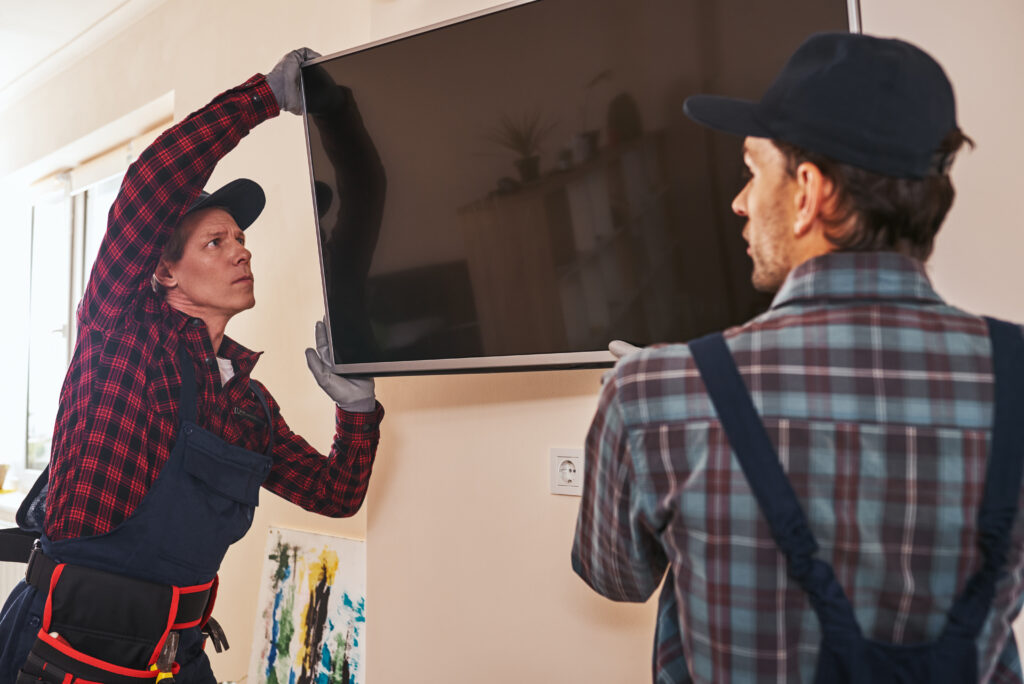
Benefits of Professional TV Mounting
On this page · 10 sections
A new TV usually comes home on a Saturday, and by Saturday afternoon somebody is standing in the living room holding a drill and a box of anchors, wondering how hard this could really be. Sometimes the answer is: not very. A light set on a fixed bracket, going into drywall with studs right where you want them, is a job plenty of homeowners handle themselves. But a lot of TVs we get called about were mounted once already, and they're crooked, sagging away from the wall, or hanging by hardware that was never meant to hold that much weight.
This post walks through what professional mounting actually gets you, where the DIY version tends to go wrong, and how to tell which side of the line your setup is on. If you're still deciding where the TV should go in the first place, start with our guide to mounting a TV in any room and come back here.
The short answer
Bottom Line Up Front
If it's a light TV on a fixed mount, going into drywall with studs right where you want them, and you own a stud finder, a level, and a drill, you can probably do it yourself. If the TV is large, the mount swings out, the wall is plaster or masonry, or it's going over a fireplace, have it professionally mounted.
A professional install isn't about the drilling. It's about knowing what's behind the wall, matching the hardware to it, getting the screen level at a height you can actually watch, and planning the cables so the finished wall looks done. Those are the parts that go wrong on a first try, and they're the parts you live with every time you turn the TV on.
opened for business
(Better Business Bureau)
(after we look at the wall)
The rest of this post covers the five things a professional install gets right, a side-by-side comparison, and a decision table at the end that sorts most setups in about a minute.
Benefit 1: The mount is anchored into something that can hold it
Drywall by itself is not structure. It's a skin over the framing, and a bracket screwed only into it is held up by gypsum and hope. The weight on a TV mount isn't just the TV hanging straight down, either. It's leverage, pulling the top screws out of the wall, and it gets worse the farther the TV sits from the wall. A full-motion arm pulled out to the side multiplies that pull.
When we mount a TV, the first job is finding out what's behind the wall: where the studs actually are, whether they line up with where you want the screen, and what the wall is made of. Older homes around Sussex County can have plaster, paneling over furring strips, or framing that isn't on the spacing a stud finder expects. The hardware follows from what's there, not from what came in the box.
The plastic anchors and toggle bolts in a hardware store aisle are rated for pictures and shelves, not for a TV pulling forward off a bracket. Follow the mount manufacturer's instructions for what it has to be fastened into, and if the studs aren't where the TV needs to go, that's a problem to solve before anything goes on the wall, not after.
Benefit 2: It's level, centered, and at a height you can watch
A TV that's a few degrees off level is the kind of thing you never stop noticing. So is a screen that sits too high, leaving everyone on the couch tipping their heads back for the length of a movie. Getting it right means measuring from where you actually sit, centering on the furniture or the wall as the room calls for, and checking level on the bracket before the TV ever goes on it.
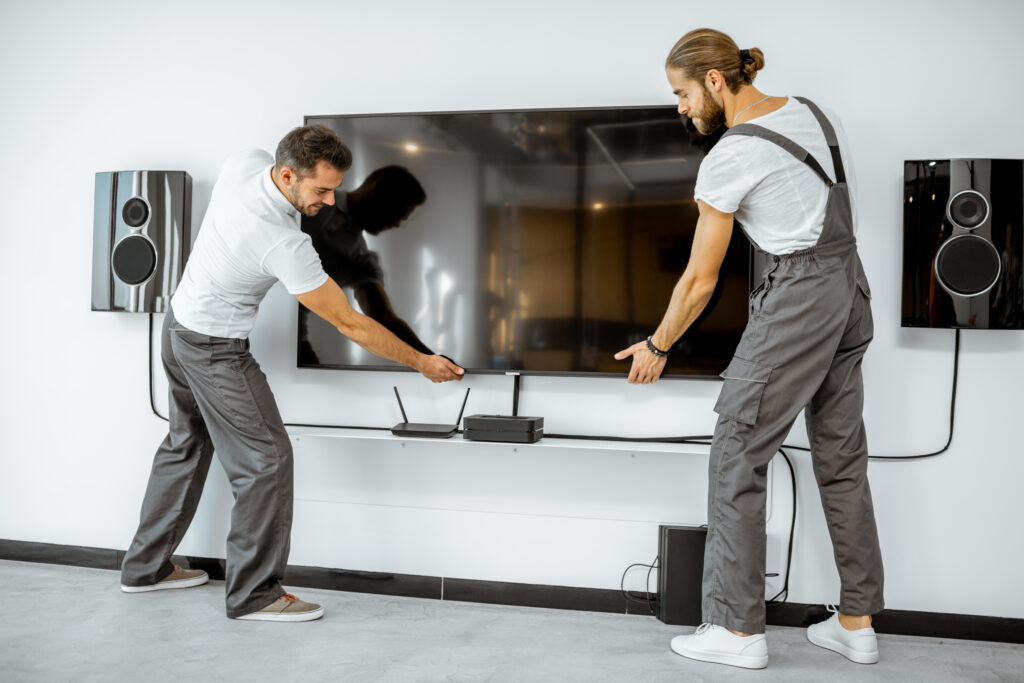
DIY vs. professional at a glance
Here's the comparison we'd walk you through in person. Each row is something that changes how the job turns out; the highlighted column is the stronger choice when that row is the one you're worried about.
| Factor | Do It Yourself | Professional Install |
|---|---|---|
| Upfront spend | Just the mount and hardware | Mount, hardware, and labor |
| Finding the framing | Stud finder and a best guess | Checked before anything is drilled |
| Hardware | Whatever came in the box | Matched to the wall and the TV |
| Level and height | Eyeballed, then adjusted | Measured from where you sit |
| Lifting the TV | You and whoever is around | Handled without pressing the screen |
| Cables | Often left hanging | Planned before the TV goes up |
| Wall damage | Extra holes from missed studs | Holes where the bracket goes |
| Your time | An afternoon, plus a store run | Your Saturday stays yours |
Benefit 3: Cables, outlets, and the details that make it look finished
A mounted TV with a tangle of cords hanging under it looks like a job that stopped halfway. Before anything goes on the wall, we talk through where the power is, where the cable box, soundbar, or streaming device will live, and how the cables will run between them. Planning that up front is what keeps the finished wall looking clean, and it's a lot easier to settle before the screen is in the way.
Most flat-screens have a square or rectangular pattern of threaded holes on the back for a wall bracket. The spacing of those holes and the weight of the TV are both in the owner's manual, and the mount you buy has to match both. Have those two numbers handy when you reach out and the rest of the conversation gets much shorter.
Benefit 4: Your wall and your TV come through it in one piece
The most common DIY damage isn't a TV falling. It's the wall: extra holes from missed studs, torn drywall paper around an anchor that spun, a scuffed paint finish from a bracket set and reset three times. Then there's the TV itself, which is thin, heavy, and awkward to lift into place without pressing on the screen. Since we also do interior painting and carpentry and trim work, we look at that wall the way we'd look at our own.
“We treat your home as though it were our own. If we wouldn’t be satisfied with that work in our house, we won’t leave yours that way.”— AEB Services, Inc.
Signs you can do it yourself
A light TV, a simple bracket, and an easy wall. Take your time and it will go fine.
What we'd look for
- The TV is small and light enough for one person to hold steady at arm's length.
- The mount is a fixed or tilting bracket that sits flat against the wall.
- The wall is drywall over wood studs, and the studs fall where the TV needs to go.
- You already own a stud finder, a level, and a drill, and you've used all three.
Signs it's time to hire it out
The weight, the wall, or the location raises the stakes. This is where a professional install pays off.
What changes the answer
- The TV is big enough that lifting it takes two people and someone else holding the level.
- The mount is a full-motion arm that pulls the TV out from the wall and swings it to the side.
- The wall is plaster, brick, or masonry, or the studs aren't where the screen should go.
- The TV is going above a fireplace, or you want the cables out of sight.
Benefit 5: You get your Saturday back
There's also the plain fact that a first-time mount takes a while: reading the bracket instructions, borrowing a stud finder, making a run to the hardware store for the right bolts, and then finding a second person to help lift. For a lot of the homeowners we work with, including many seniors who would rather not be on a ladder holding something heavy overhead, that alone settles it. (If that sounds familiar, our post on handyman help for seniors covers more of the jobs worth handing off.)
How to choose who mounts it
If you do hire it out, start with the basics: hire a legal company. There are a lot of people in this industry who aren't properly registered or insured, and a TV install is still someone drilling into your house. Then ask the simple question: have you done this type of work before? Hanging a picture doesn't qualify anyone to mount a large TV on a swing-out arm over a fireplace. Our post on how to hire a handyman goes further into what to ask.
The decision table
If you only read one part of this post, read this. Find the rows that describe your setup and see which column wins most of them. Most installs fit more than one row, and the right call is whichever side wins the most of your rows.
| If your setup… | DIY | Hire a Pro |
|---|---|---|
| Is a light TV on a fixed bracket | Yes | Optional |
| Is a large TV | Two people minimum | Yes |
| Uses a full-motion arm | Risky | Yes |
| Goes above a fireplace | Hard to get right | Yes |
| Is on plaster, brick, or masonry | Wrong hardware risk | Yes |
| Needs the cables tidied or hidden | Plan it first | Talk it through |
| Means borrowing every tool you need | Not worth it | Yes |
| Is easy for you on a ladder, lifting overhead | Possible | Your call |
The bottom line
A small TV on a fixed bracket in an easy wall is a fair DIY job, and we'd tell you so. The setups that are worth handing off are the ones where the stakes go up: a big screen, a mount that swings out, a fireplace, a plaster or masonry wall, or cables you want out of sight. That's where proper anchoring, a level line, and a careful lift make the difference between a TV you stop thinking about and one you keep checking on.
Here's how it works with us: you tell us what you want, we set up a time to come look at the wall, and you get a quote, which in most cases is free. See what's included on our TV mounting services page, or if you're up near the beaches, read about our TV mounting in Lewes.