
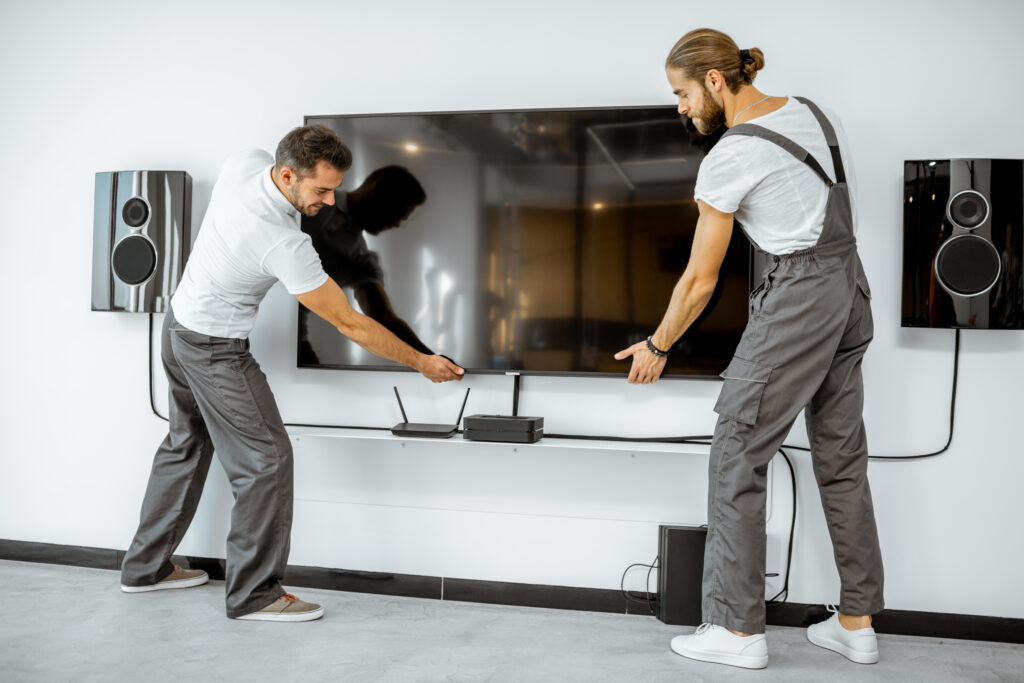
The complete guide to TV mounting in any room
On this page · 8 sections
When homeowners around Sussex County call us about a new TV, the question usually isn't whether it can go on the wall. It's where. Over the fireplace because that's where the furniture points? Above the dresser so it can be seen from bed? On the one open wall in a kitchen that flows into the living room? Get the spot wrong and you live with a sore neck, a screen full of window glare, or a set of holes in the drywall you'd rather not explain.
The good news is that the right spot almost always comes down to four questions: where you'll actually be sitting, what's behind the wall, how the room gets used, and where the light comes from. Answer those four and the wall, the height, and the type of mount mostly pick themselves. Here's how we walk through it with homeowners before a single hole goes in.
The short answer
Bottom Line Up Front
Mount the TV so the center of the screen sits near your eye level from where you actually sit, on a wall with solid framing behind it, facing away from the brightest window. If you watch from more than one spot, or the only workable wall is a corner, go full-motion. Otherwise, a fixed or tilting mount is simpler and sits tighter to the wall.
The most common mistake is mounting too high, usually over a fireplace or centered on a tall wall because it looks balanced from the doorway. The second is trusting drywall instead of the studs. Plan the spot from the seat, confirm what's inside the wall, and choose the mount for how the room is used, and the TV will be comfortable to watch for as long as you own it.
modern wood-frame walls
for seated living room viewing
typically cost
The rest of this post is the reasoning behind that answer, room by room, with a comparison of mount types and a decision matrix at the end that gets most people to the right setup in a couple of minutes.
Question 1: Where will you actually be sitting?
Start with the couch, the bed, or the chair, not the wall. The most comfortable screen is one you look at straight on, with the center of the picture close to your eye level when you're settled in. That's why the most common mistake we see is a TV hung too high: it looks tidy when you walk into the room, then forces everyone to tilt their heads back for a two-hour movie.
Sit where you normally watch and have someone hold a piece of painter's tape on the wall where your eyes land. That mark is a better starting point than any rule of thumb, because it accounts for your furniture, your height, and how you like to sit. If the household watches from two places, say the sofa and the kitchen island, note both. That second mark is what tells you whether a simple mount will do or whether you need one that moves.
Question 2: What's behind the wall you picked?
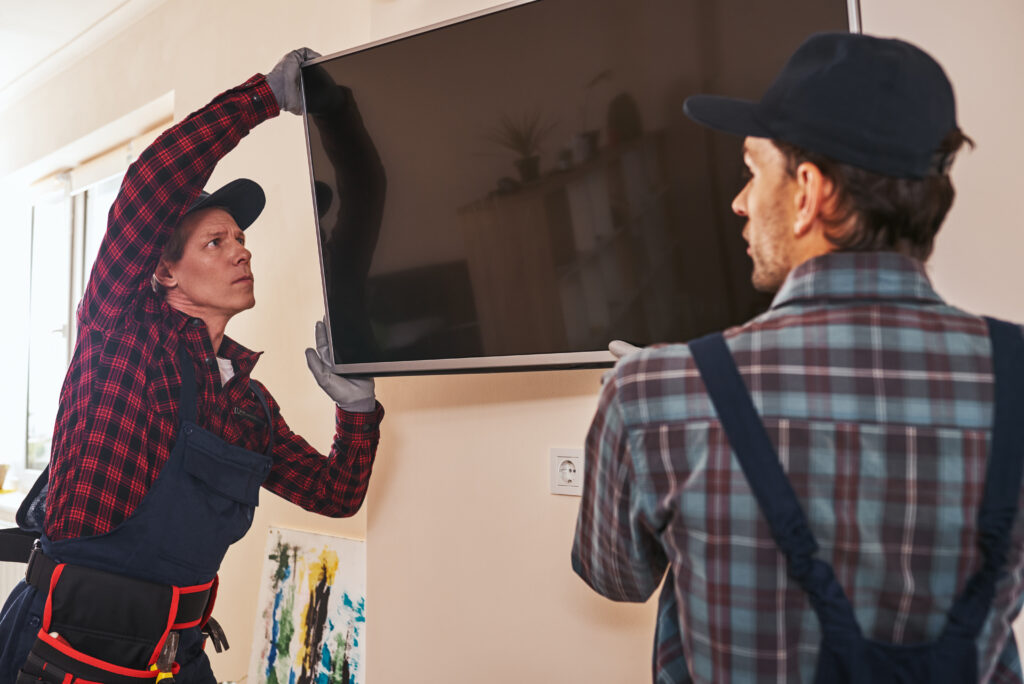
A TV mount is only as strong as what it's fastened to. In most wood-frame homes, that means the studs, not the drywall between them. A drywall anchor that's fine for a picture frame is not what you want holding a large flat-screen, especially on a mount that extends out on an arm and adds leverage every time someone pulls it toward them.
Older homes and some beach houses add a wrinkle: plaster walls, brick, block, or framing that doesn't sit where you'd expect. None of those rule a wall out, but each one changes the hardware and the approach. Before you commit to a spot, it's also worth knowing what else is inside that wall, because the place that looks perfect for a TV is sometimes exactly where a wire or a pipe runs.
Run a stud finder across the wall you're considering and mark every stud with painter's tape, then find the nearest outlet. If the studs don't line up with where the bracket needs to go, or the cords would have to dangle across a long stretch of wall, you'll know before any holes are drilled. A spot a few inches to one side is often a much better spot.
Fixed, tilting, or full-motion: mount types at a glance
The mount you choose decides how much the TV can move once it's up. Here's the comparison we'd sketch on the back of a quote. Each row is a real factor, and the highlighted side is the better fit when that factor is the one driving your decision.
| Factor | Fixed or Tilting Mount | Full-Motion Mount |
|---|---|---|
| Where you watch from | One main seat, straight on | Several spots around the room |
| Room size | Sits close to the wall | Extends out on an arm |
| Wall strength needed | Less leverage on the wall | Needs solid anchoring into framing |
| Look when the TV is off | Flat and tidy | Bulkier, folds back |
| Corner placement | Awkward fit | Built for it |
| Glare from a side window | Tilt helps only with light from above | Swivel the screen away |
| Open kitchen and living room | Faces one direction only | Turns toward either space |
| Getting to the ports | Usually means lifting the TV off | Pull it out and reach behind |
General guidance, not a rule for every wall. Your room likely matches more than one row — the right mount is whichever column wins the most of your rows.
Above the mantel is the most requested TV location we see, and it's often the hardest on the people watching. It usually puts the screen well above eye level, and a working fireplace sends heat and soot straight up toward the electronics. If the fireplace wall really is the only option, check your TV maker's guidance on heat, plan for a mount that tilts the screen down toward the seating, and confirm what the chimney and the wall above the mantel are made of before you drill.
Question 3: How does this particular room get used?
Living rooms are where the TV competes with everything else: windows, the fireplace, doorways, and the walkway through the room. The best wall is usually the one directly across from the main seating, with nothing behind the viewer that throws light onto the screen. In open rooms with vaulted ceilings, resist the urge to go high just because there's space up there.
Bedrooms flip the rule on eye level, because you're often watching from a pillow rather than a chair. That can justify mounting a little higher over a dresser, with a tilting mount angling the screen down toward the bed. Kitchens and open floor plans are where full-motion mounts earn their keep, letting a screen face the island while you cook and swing back toward the couch later. In small rooms and dens, a slim fixed mount keeps the TV tight to the wall so it doesn't eat floor space; our post on making small spaces feel bigger has more ideas for rooms like that.
Good spots for a TV
The wall works for the viewer, the hardware, and the light. Mount it and enjoy it.
What we look for
- The wall sits directly across from where you watch, with nothing to walk past in between.
- The center of the screen can land close to your eye level from the main seat.
- Studs or other solid framing sit where the bracket needs to fasten.
- An outlet is close by, and no big window faces the screen.
Spots to rethink
Something about the wall works against the viewer. A different wall or mount usually fixes it.
What changes the answer
- You have to tip your head back to see the middle of the screen from your seat.
- A window or glass door is directly across from the wall and lights up the screen.
- A stud finder turns up nothing solid where the bracket would go.
- The wall is above a fireplace you use regularly.
Question 4: Where does the light come from?
A TV facing a big window will reflect it for half the day, and a screen on the wall opposite a sliding door can be nearly unwatchable in the afternoon. Before you settle on a wall, stand where you'll sit at the time of day you watch most and look at where the light lands. Side light from one window can often be handled with a mount that swivels a few degrees away. Light from directly behind the seating usually means a different wall, or at least window treatments, before the TV goes up.
“The wall that looks right when you walk into the room isn’t always the one that’s right from the couch. We plan the spot from where you’ll be sitting, then work back to the wall.”— AEB Services, Inc.
The decision matrix
If you only read one part of this post, read this table. Find the rows that describe your room, then see which column comes out ahead. Most rooms match more than one row, so the right mount is whichever column wins the most of your rows.
| If your room… | Fixed or tilting | Full-motion |
|---|---|---|
| Has one main seat facing the wall | Yes | More than you need |
| Is watched from the couch and the kitchen | Locks you to one view | Yes |
| Only has a corner for the TV | Awkward fit | Yes |
| Gets glare from a side window | Tilt helps a little | Swivel it away |
| Needs the TV above a dresser, watched from bed | Tilting, yes | Works too |
| Is small, where every inch of depth counts | Sits tight | Sticks out |
| Has devices you plug and unplug often | Lift it off to reach | Pull it out |
The bottom line
Most TV placement problems come from choosing the wall first and the viewer second. Start from the seat, keep the center of the screen near eye level, fasten into solid framing, and keep the screen out of the brightest light, and you've solved most of it. Then pick the mount that matches how the room is used: fixed or tilting for one main view, full-motion for corners, open floor plans, and households that watch from more than one place.
If you'd rather have it done right the first time, that's what our TV mounting service is for. We talk through what you want, set up a time to look at the room and the wall, and give you a quote, which is typically free. We mount TVs across Sussex County, from homes in Lewes to Rehoboth Beach and back home to Millsboro. Still weighing whether to hire it out? Our post on the benefits of professional TV mounting covers that, and our frequently asked questions answer the rest.