
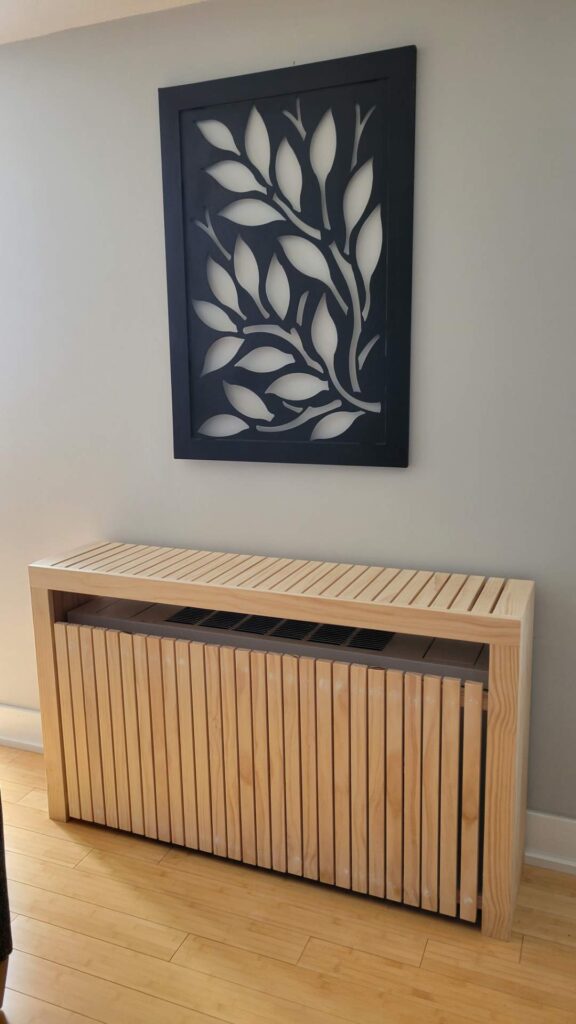
Custom radiator covers vs. store-bought: which one fits your home?
On this page · 8 sections
Almost every home has one corner nobody wants to look at. Often it's the radiator or wall heating unit: scuffed panels, rust stains around the screws, a grille that has seen better decades. Homeowners ask us about it all the time, usually while we're there for something else, and the question is nearly always the same: can I just buy a cover for that, or does it need to be built?
It's a fair question, and the honest answer is that it depends on the corner. A store-bought cover is the right call more often than a carpenter might like to admit. But plenty of heating units sit in spots no catalog size was ever meant for: tucked between a wall column and a window, crowded by baseboard, or fitted with valves and access panels that still need reaching. Here's how we help homeowners sort out which situation they're in.
The short answer
Bottom Line Up Front
If your heating unit is a standard size on an open wall with nothing crowding it, a well-ventilated store-bought cover is usually all you need. If it sits in a corner, under a low window, against baseboard or trim, or has valves you still need to reach, have one built to fit.
A custom cover isn't automatically better. It's better when the space is awkward, when the finish needs to match the room, or when you want the cover to work as a shelf. The trick is knowing which kind of corner you have before you spend money on a box that won't sit flush.
The rest of this post walks through the four questions behind that answer, with a side-by-side comparison and a decision table at the end that gets most homeowners to a clear choice in a couple of minutes.
Question 1: Is your heating unit a standard size with nothing in the way?
Store-bought covers come in set widths, heights, and depths. If your unit sits against an open stretch of wall, with no window sill overhead and no baseboard, pipe, or trim in the way, there's a decent chance one of those sizes will slide right over it. That's the easy case, and in the easy case there's no reason to pay for custom work.
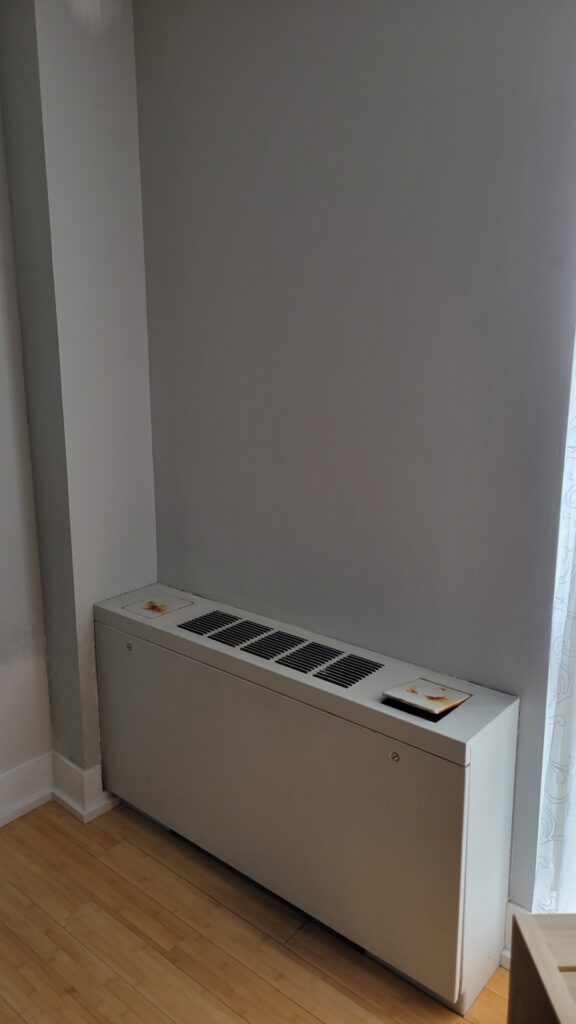
The trouble starts in the corners. A unit tucked beside a wall column, a window that hangs low over the grille, baseboard trim that runs right up to the side panel: each of those is a reason a factory box ends up sitting crooked, leaving gaps at the wall, or not fitting at all. That's where a cover built to the actual space earns its keep, and it's the same measure-and-fit work we do on every carpentry and trim job.
Store-bought vs. custom-built at a glance
This is the comparison we'd walk you through standing in front of the unit. Each row is a real factor, and the highlighted column is the smarter call when that factor is the one that matters most to you.
| Factor | Store-Bought | Custom-Built |
|---|---|---|
| Upfront cost | Usually the lower number | Quoted after we see the space |
| How fast you have it | Buy it and set it in place | Measured, quoted, then built |
| Fit in the space | Set sizes only | Built to the actual corner |
| Around trim, sills, and pipes | Often gaps or won't fit | Built around them |
| Access to valves and panels | Depends on the design | Planned in from the start |
| Finish | A few factory colors | Natural, stained, or painted to match |
| Extra use | Mostly a cover | Can double as a shelf |
Your corner is likely more than one row. The right call is whichever column wins the most of your rows.
Before you shop, measure the heating unit's width, height, and depth, then measure what's around it: the distance to the window sill, how far the baseboard sticks out, and where any pipes or valves come through the wall or floor. If a store-bought cover fits the unit but not the surroundings, it won't sit right. Those extra measurements tell you within a few minutes whether you're in store-bought territory or not.
Question 2: Will the heat still get out?
A cover is a box around something that's supposed to warm the room, so how it breathes matters more than how it looks. A cover with a solid front and a solid top can trap warm air inside the box instead of letting it move into the room. The covers that work best leave the heat a clear path out: open slats across the front, an open or slatted top, and room for air to move underneath.
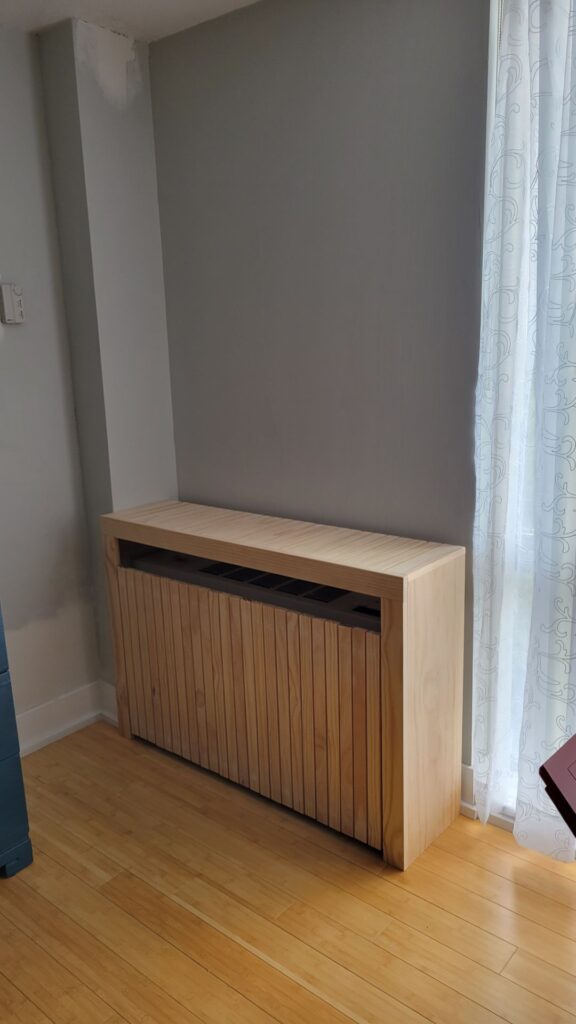
Some store-bought covers are designed well for airflow and some are mostly decoration. If you're buying one, look closely at how much of the front and top is actually open. If you're having one built, the slat spacing and the openings are part of the design from the start, not an afterthought.
Question 3: What do you still need to reach behind it?
Heating units have valves, bleed points, access panels, and screws that someone will need to get at eventually, whether that's you in October or a heating service in the middle of winter. A cover that has to be pried off the wall, or that blocks a panel completely, turns a five-minute check into a project. Before anything gets built, we look at what's behind the unit and plan the access around it, so the cover lifts off or opens up where it needs to.
If the unit is leaking, making new noises, not heating evenly, or showing more than surface rust, have the heating system checked before anyone builds a box around it. A handsome cover over a failing unit just means the next repair starts with taking the cover apart. Get the heat sorted first, then make the corner look good.
Question 4: Should the cover match the room or just disappear?
Store-bought covers usually come in a handful of finishes, most often white. That works fine in a room with white trim and nothing else to match. But if the cover sits next to stained woodwork, painted wainscoting, or trim you've recently updated, a factory finish can look like exactly what it is. A built cover can be left as natural wood, stained, or painted to match the trim around it, and our interior painting work means the finish can be handled as part of the same job. A built cover can also do double duty, with a solid top that works as a shelf, the same way custom cabinets are built around the room instead of the other way around.
Signs store-bought will do
The space is simple and the finish doesn't need to match anything. Buy one and move on.
What we look for
- The heating unit sits on an open stretch of wall with nothing crowding either side.
- There's no window sill, shelf, or trim hanging low over the top grille.
- Its width, height, and depth line up with a size you can actually buy.
- A plain white finish looks fine next to the trim already in the room.
Signs it's worth building custom
The corner is awkward or the room deserves better. A cover built to fit pays off here.
What changes the answer
- The unit is wedged between a wall column and a window, or tucked into a corner.
- Baseboard, pipes, or valves stick out where a factory box needs to sit flush.
- The cover sits beside stained or painted woodwork it needs to match.
- You want the top to work as a shelf or ledge, not just a lid.
“We treat your home as though it were our own. If we wouldn't be satisfied with a cover that sits crooked in our own living room, we won't leave one that way in yours.”— AEB Services, Inc.
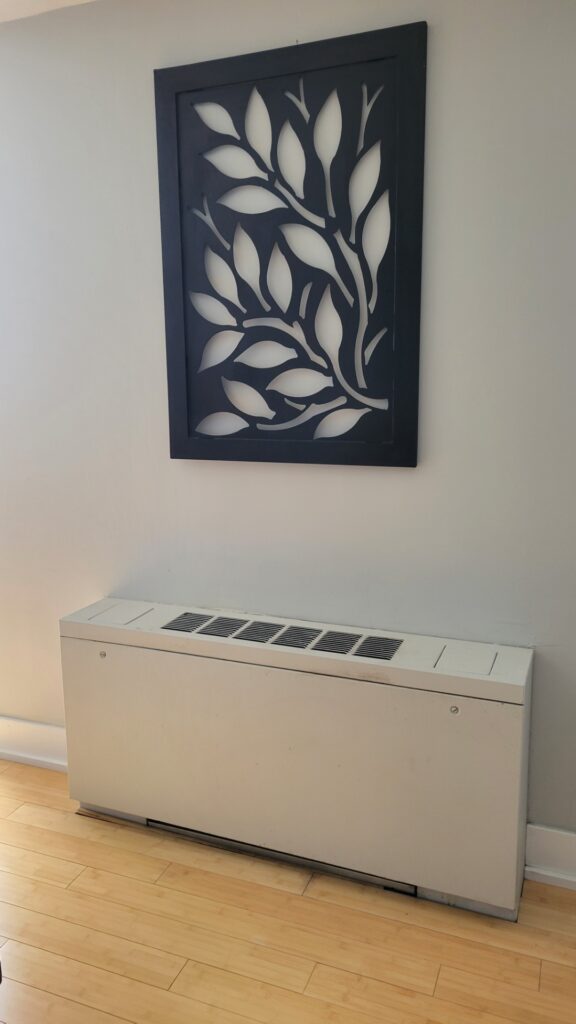
Same corner, two approaches. Drag the divider to compare a factory-style metal cabinet (left) with a slatted pine cover built for the same spot (right).
The decision table
If you only read one part of this post, read this. Find the rows that describe your heating unit and see which column wins more of them. Most corners are more than one row, so go with whichever side wins the most of your rows.
| If your heating unit… | Store-Bought | Custom-Built |
|---|---|---|
| Is a standard size on an open wall | Yes | More than you need |
| Sits between a wall column and a window | Rarely fits | Yes |
| Has baseboard or pipes in the way | Won't sit flush | Built around them |
| Has valves or panels you need to reach | Check the design | Access planned in |
| Needs to match stained or painted trim | Close, not exact | Yes |
| Should double as a shelf | Some models | Yes |
| Is leaking or not heating right | Fix the heat first | Fix the heat first |
The bottom line
If your heating unit is a standard size on an open wall, buy a well-ventilated cover and enjoy the money you saved. If it's wedged into a corner, crowded by trim or a window, has valves you need to reach, or sits in a room where a factory finish would stick out, that's when building one to fit is worth it.
Not sure which side of the line you're on? Tell us what you're looking at, and we'll set up a time to come see the space and give you a quote, which is typically free. While we're there, we're glad to look at the rest of your list too; our handyman services cover a lot of the small jobs that tend to pile up. You can see more of our finished carpentry in the project gallery.